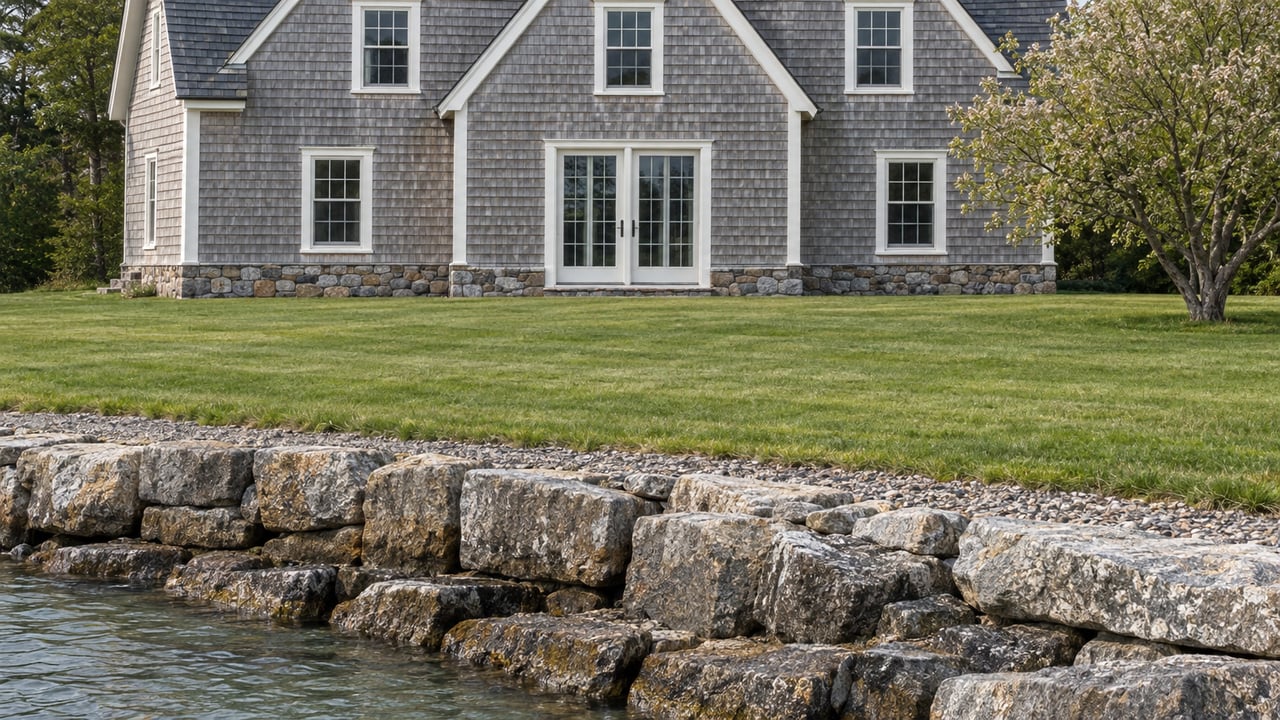
According to Newport Buzz, homeowners set out to replace a 1,600-square-foot cottage on Washington Street with a modest three-bedroom, two-and-a-half-bath home. Five years, several redesigns, and repeated hearings later, they were still returning to the Coastal Resources Management Council for a setback variance, opposed by a small group of neighbors in Newport's Point neighborhood. The project has already cleared the Newport Historic District Commission, the Newport Zoning Board, and the Rhode Island Historical Preservation and Heritage Commission. What keeps it in front of regulators is the shoreline itself, and exactly where a private lot stops and public trust land begins.
That question is not unique to one cottage on Washington Street. Rhode Island rewrote the answer by statute in 2023, a group of waterfront owners sued to overturn it, a Superior Court judge sided with them in 2024, and the fight is now working its way toward the Rhode Island Supreme Court. In the middle of all of that, the state passed a separate law requiring sellers of vacant land or land with one to four dwelling units to disclose known public rights of way and provide related documentation before closing. For a Newport waterfront transaction involving property covered by the disclosure law, that combination of an active legal fight and a live disclosure obligation is the part that a listing photo will never show.
The Ten Feet That Rewrote Every Deed's Fine Print
For four decades, Rhode Island measured public shoreline access against the mean high tide line, a boundary set by the 1982 state Supreme Court case State v. Ibbison and calculated from an 18.6-year tidal cycle. It was legally precise and functionally useless to anyone standing on a beach trying to figure out where they were allowed to walk.
In June 2023, the General Assembly replaced that standard. The new law, described by the Rhode Island Association of REALTORS®, gives the public the right to access shoreline property on wet sand, dry sand, or rocky beach up to ten feet landward of the "recognizable high tide line," identified by seaweed lines, shell deposits, or similar debris left by the tide. It is easier to eyeball than the old mean high tide line. It is also, depending on where a house sits, a meaningfully larger strip of what used to be considered private yard.
What Sellers of Covered Newport Properties Have to Put in Writing
A year after that boundary shifted, lawmakers addressed a related problem. Governor Dan McKee signed H7376A on June 17, 2024, and it took effect immediately.
The law requires sellers of vacant land or land with one to four dwelling units to give buyers:
- a written disclosure of any public rights of way the seller knows about on the property
- copies of any documentation in the seller's possession showing those rights of way or conditions of public access
- a pointer to the Coastal Resources Management Council, the municipality, or applicable nonprofit organizations if the buyer wants to confirm whether other rights of way exist beyond what the seller disclosed
The Rhode Island Association of REALTORS® updated its standard Real Estate Sales Disclosure form to include this language. For most Newport waterfront sales, which involve single-family homes rather than larger multi-unit buildings, this disclosure is now a standard part of the paperwork rather than an optional add-on.
A Boundary Still Moving Through the Courts
The ten-foot standard is currently being challenged in Rhode Island courts by the property owners it affects most directly.
Stilts, LLC filed suit arguing the new law amounts to an unconstitutional taking of private property. Westerly homeowners filed a similar complaint. In July 2024, Rhode Island Current reported that Superior Court Associate Justice Sarah Taft-Carter sided with both property owners, writing that the 2023 law's boundary was "whimsical and inconsistent" compared to the mathematically precise, if impractical, mean high tide line set by Ibbison. The state appealed.
The East Greenwich Pendulum reported in January 2026 that the dispute did not end there. The Coastal Resources Management Council later attached similar access and inspection conditions to a storm-repair permit for a homeowner on the same Charlestown Beach Road, an approach Pacific Legal Foundation attorney David Breemer called an attempt to reach the same result through permitting rather than statute. A Superior Court judge blocked those permit conditions too. At that time, the state had appealed both rulings to the Rhode Island Supreme Court, setting up a case that Sean Lyness, an assistant professor at New England Law Boston who advised legislators on the original bill, expects will finally settle what the 1986 amendment to Rhode Island's constitution actually means for shoreline rights nearly forty years later.
None of that changes what happens on the ground today. Rhode Island Current quoted Lyness after the 2024 ruling: "for your average Rhode Islander, this decision doesn't really change anything."
What This Means at a Newport Closing Table
A Newport sale of property covered by the disclosure law now carries a due diligence step. Beyond the usual inspection, a buyer working through a coastal property should ask the seller directly for any documentation of rights of way, past CRMC permits, or prior disputes involving the shoreline. A seller should gather that paperwork before listing rather than assembling it under deadline once an offer is in hand.
This matters even more on stretches of Newport's waterfront with a documented public access history. Friends of the Waterfront, a nonprofit founded in 1982, worked with CRMC to designate points of public right-of-way along Newport's shoreline and later developed the Harbor Walk, a roughly 2.5-mile public path running from Washington Street to King Park on Wellington Avenue. A property on or near that corridor, including the section of Washington Street where the dispute is playing out, sits along ground with a specific, documented access history that a generic title search will not surface on its own.
For anyone planning dock work, an addition, or new construction close to the water, the practical lesson from the Point neighborhood fight is that CRMC review sits alongside, not underneath, local historic and zoning approval. A project can clear the Newport Historic District Commission, the Zoning Board, and the state's Historical Preservation and Heritage Commission and still spend years in front of CRMC because the shoreline setback question is a separate track entirely.
Why the Point Dispute Matters Beyond One Cottage
The property is not, by Newport waterfront standards, large. The planned home is roughly 3,400 square feet. The dispute highlights the jurisdictional overlap and boundary ambiguity relevant to Newport waterfront transactions, whether a property ever ends up in a hearing room or not.
Frequently Asked Questions
Does the shoreline disclosure law apply to waterfront condominiums? The law specifically covers vacant land and land with one to four dwelling units. Larger condominium buildings or association-owned shoreline may fall outside that threshold, so it is worth asking directly whether the disclosure requirement applies to a specific building or whether shoreline access documentation exists through the association instead.
Do I need a new survey before selling a Newport waterfront home? If there is any planned dock work, addition, or structure near the water, gathering existing CRMC permits and any past agreements about access is more useful than commissioning a new survey solely for the sale.
Is this the same issue as flood zone disclosure? No. Shoreline access disclosure is about the public's legal right to pass along the shore. Flood zone status is a separate determination handled through different documentation, and buyers should treat the two as distinct items in their due diligence rather than assuming one covers the other.
Rhode Island's shoreline-access law is unsettled at the highest level, while the disclosure requirement applies at closing to properties it covers. Getting any required disclosure right, and understanding what it does and does not protect, is exactly the kind of detail worth a direct conversation before a Newport waterfront listing goes live or an offer goes in. William Darling is available to walk through what a specific property's shoreline history means for a sale or purchase.
This article is general information, not legal, tax or financial advice. Consult a qualified professional about your situation.